
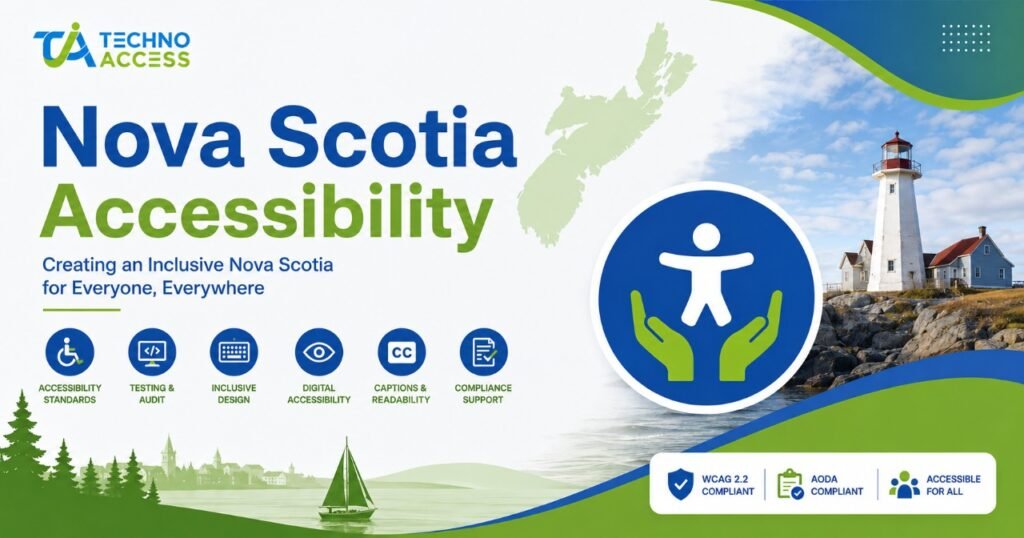
Nova Scotia is on a defined path toward becoming an accessible province by 2030. Through the Accessibility Act, passed in 2017, the province has laid out a clear legal framework requiring public sector bodies and, increasingly, private organizations to identify, remove, and prevent barriers faced by people with disabilities. accessibility consultants evaluate digital platforms,staff training.Whether you run a municipal office, a healthcare facility, an educational institution, or a growing business, understanding Nova Scotia accessibility requirements is essential – not only for legal compliance but for building trust with the community you serve.
At Techno Access, we work with organizations throughout Nova Scotia to translate accessibility legislation into practical, measurable action. This guide walks through what the Accessibility Act means, who it applies to, the standards being developed, and how your organization can move confidently toward full compliance.
The Accessibility Act is provincial legislation designed to make Nova Scotia accessible by removing barriers in key areas of daily life. Unlike a single, one-size-fits-all rule, the Act works through the development of accessibility standards – detailed regulations covering specific sectors and areas of public life. These standards are created with input from the Accessibility Advisory Board and members of the disability community, ensuring the rules reflect lived experience rather than abstract policy.
The Act identifies several priority standard areas, including:
Each standard is rolled out in phases, giving organizations time to plan, budget, and implement changes. However, “time to prepare” doesn’t mean compliance can wait. Early adoption of accessible practices reduces the cost and disruption of last-minute retrofits, whether those retrofits involve physical infrastructure or digital platforms like websites and online service portals.
The Accessibility Act primarily targets public sector bodies, which include:
These organizations are required to develop accessibility plans, consult with people with disabilities, and align their operations with published standards as they come into force. Public sector bodies with fewer resources are often given extended timelines, but the underlying obligation to plan for accessibility applies broadly across the sector.
Private businesses aren’t currently bound by the same mandatory timelines, but that’s changing. As standards mature and public expectations shift, more private organizations – particularly those serving the public directly, such as retailers, restaurants, and service providers – are choosing to align voluntarily. Nova Scotia Accessibility Act .Doing so isn’t just good citizenship; it’s good business. Nova Scotia is home to a growing population of seniors and people with disabilities, and accessible spaces and services directly translate into a broader, more loyal customer base.
Accessibility barriers often exist in places organizations don’t immediately think to look. In Nova Scotia, three areas consistently present the greatest challenges – and the greatest opportunities for improvement.
Physical spaces such as entrances, washrooms, parking, and signage are the most visible accessibility concerns. Ramps without proper gradients, doors too heavy to open independently, and poorly placed signage can all exclude people with mobility, visual, or cognitive disabilities. Nova Scotia Accessibility Act . A thorough facility assessment is often the starting point for any organization serious about compliance.
As more services move online, digital accessibility has become just as critical as physical accessibility. Websites with poor color contrast, inaccessible PDF documents, forms that can’t be completed using a screen reader, or videos without captions all create real barriers for Nova Scotians with disabilities. Given that information and communication is an explicit standard area under the Act, organizations should treat their digital presence with the same scrutiny as their physical locations. Techno Access offers dedicated web accessibility audit services to identify and resolve these digital gaps, ensuring your website and online services meet WCAG 2.1 guidelines and provincial expectations alike.
Recruitment processes, workplace accommodations, and internal communication tools can unintentionally exclude qualified candidates and employees with disabilities. From inaccessible job application portals to a lack of accommodation policies, employment barriers often go unnoticed until an employee or applicant raises a concern. Building inclusive hiring and workplace practices early helps organizations avoid both compliance gaps and missed talent.
A strong accessibility plan does more than satisfy a legal requirement – it creates a roadmap for genuine, lasting inclusion. Nova Scotia Accessibility Act.Effective plans in Nova Scotia typically include:
Because accessibility standards under the Act continue to evolve, plans should be treated as living documents, reviewed and updated as new regulations are introduced. Organizations that build flexibility into their accessibility planning from the outset are far better positioned to adapt without scrambling.
Techno Access supports organizations through every stage of this process, from initial barrier identification to full remediation and staff training. Our WCAG compliance solutions pair technical expertise with practical implementation support, so your accessibility plan translates into real, usable improvements rather than a document that sits on a shelf.
Meeting Nova Scotia accessibility requirements calls for more than good intentions – it requires a structured, informed approach backed by real expertise. Techno Access brings together technical accessibility specialists and compliance experts to help public sector bodies, healthcare institutions, educational organizations, and private businesses build accessible environments that work for everyone.
Contact Techno Access today to schedule a consultation. Our team will assess your current facilities, digital platforms, and organizational practices, then build a clear, actionable plan tailored to Nova Scotia’s accessibility standards.
Reach out now and let’s build a more inclusive Nova Scotia together.
The Nova Scotia Accessibility Act is provincial legislation requiring organizations to identify, remove, and prevent barriers for people with disabilities.
The Nova Scotia Accessibility Act was passed in 2017, setting a goal of an accessible province by 2030.
The Nova Scotia Accessibility Act sets a target of 2030 for Nova Scotia to become a fully accessible province.
Municipalities, school boards, hospitals, and universities are primarily bound by the Nova Scotia Accessibility Act's requirements.
The Nova Scotia Accessibility Act covers the built environment, education, employment, goods, services, and communication.