
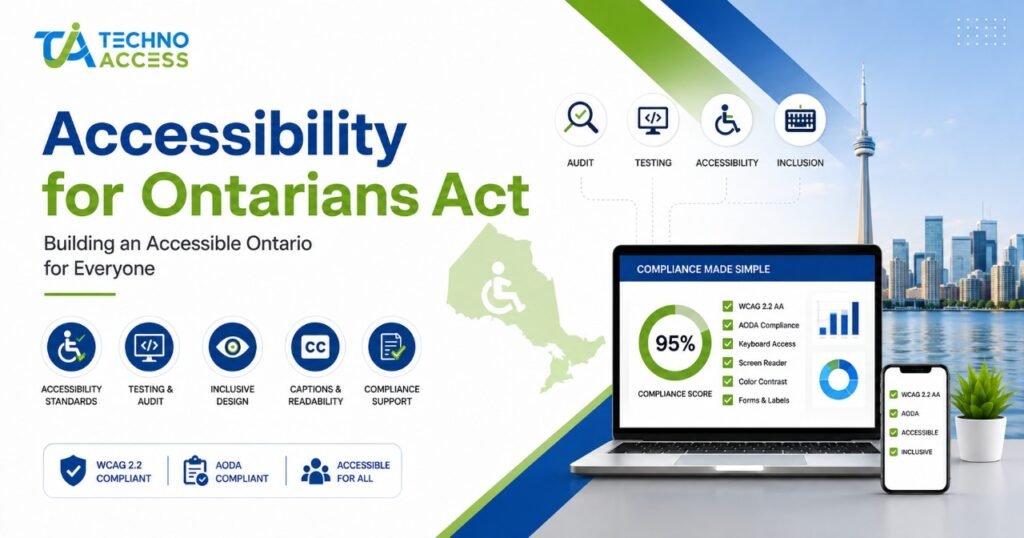


Ontario was the first province in Canada to pass comprehensive accessibility legislation with a firm target date attached – and that commitment continues to shape how businesses, schools, healthcare providers, and government bodies operate across the province today. The Accessibility for Ontarians with Disabilities Act (AODA), passed in 2005, sets out a clear goal: make Ontario fully accessible by 2025. With that deadline now here, understanding your obligations under the Act has never been more urgent.
At Techno Access, we help organizations of every size navigate AODA requirements, from initial gap assessments to full remediation across physical and digital environments. Accessibility consulting Ontario.This guide breaks down what the Accessibility for Ontarians Act requires, who it applies to, and how to move toward genuine compliance.
Enacted in 2019, the Canada Accessible Act was built around a simple but powerful principle: accessibility shouldn’t depend on individuals fighting for accommodations
The AODA was introduced to systematically identify, remove, and prevent barriers for people with disabilities across Ontario. Rather than relying solely on complaint-driven enforcement, the Act established a proactive, standards-based framework, requiring organizations to meet specific, measurable requirements across five key standards:
These standards are consolidated under the Integrated Accessibility Standards Regulation (IASR), which sets out detailed compliance requirements and timelines based on organization size and sector. Public sector organizations generally face the earliest and most stringent deadlines, while private and non-profit organizations are phased in according to their number of employees.
What makes the Accessibility for Ontarians Act distinct is its emphasis on continuous compliance rather than a single certification event. As your organization grows, launches new services, or updates its website, your obligations under the Act evolve too – making accessibility an ongoing operational responsibility rather than a project with a defined end date.
after encountering a barrier. Instead, organizations are legally required to find barriers before they cause harm and eliminate them systematically.
The legislation organizes its requirements around seven priority areas:
This structure means compliance isn’t a single project with a finish line – it’s an ongoing discipline woven into how an organization plans, hires, builds, and communicates. Organizations that treat it as a one-time initiative typically fall behind as new barriers emerge with every product launch, office renovation, or policy change.
The AODA casts a wide net, applying to virtually every organization operating in Ontario, including:
The specific requirements an organization must meet depend largely on its size and sector. Small organizations with fewer than 50 employees have somewhat reduced documentation requirements, while larger organizations – those with 50 or more employees – must maintain accessibility policies, multi-year accessibility plans, and detailed training records. Public sector organizations and larger private businesses also face website accessibility requirements under the Information and Communications Standard, requiring compliance with WCAG 2.0 Level AA at minimum.
Understanding each standard individually helps organizations prioritize their compliance efforts effectively.
This standard requires organizations to establish policies ensuring people with disabilities can access goods and services with the same quality and timeliness as everyone else. This includes training staff on accessible customer service, welcoming service animals and support persons, and providing accessible ways for customers to provide feedback.
Perhaps the most technically demanding standard, this section requires organizations to make information and communications accessible, including websites, documents, and other digital content. Public sector organizations and larger private organizations must ensure their websites meet WCAG 2.0 Level AA, covering everything from color contrast and keyboard navigation to properly structured headings and alternative text for images. Given how central digital accessibility has become to this standard, many organizations start their compliance journey here. Techno Access offers comprehensive web accessibility audit services designed specifically around WCAG conformance, helping you identify exactly where your website falls short and how to fix it.
This standard addresses accessible recruitment, hiring, and workplace practices, including individualized accommodation plans, accessible performance management processes, and return-to-work procedures for employees who have been absent due to disability.
Primarily relevant to organizations providing conventional or specialized transportation services, this standard sets requirements for accessible vehicles, boarding procedures, and route accessibility information.
This standard applies to newly constructed or redeveloped public spaces, covering elements like accessible parking, service counters, waiting areas, and recreational trails.
Meeting AODA requirements effectively requires more than a one-time checklist. Organizations that succeed long-term typically follow a structured approach:
Because WCAG conformance sits at the heart of the Information and Communications Standard, ongoing digital maintenance is often the most resource-intensive – and most overlooked – piece of long-term compliance. Techno Access’s WCAG compliance solutions are built to keep your digital properties consistently accessible, not just compliant at a single point in time, through regular testing, remediation, and staff training.
Navigating the Accessibility for Ontarians with Disabilities Act doesn’t need to be overwhelming. With the right expertise guiding your organization through gap assessments, digital audits, and staff training, compliance becomes a manageable, ongoing process rather than a source of constant uncertainty.
Contact Techno Access today for a personalized accessibility consultation. Our team will assess your current policies, facilities, and digital platforms against every applicable AODA standard, then build a clear roadmap to help you meet your obligations with confidence.
Reach out now and take the next step toward a truly accessible Ontario.Ready to bring your organization into full AODA compliance?
The Accessibility for Ontarians Act (AODA) requires organizations to identify, remove, and prevent barriers for people with disabilities.
The Accessibility for Ontarians Act was passed in 2005, aiming for a fully accessible Ontario by 2025.
The Accessibility for Ontarians Act set 2025 as the deadline for making Ontario completely accessible.
Nearly all Ontario organizations, from small businesses to hospitals, must comply with the Accessibility for Ontarians Act
The Accessibility for Ontarians Act includes five standards: customer service, information, employment, transportation, and public spaces.