
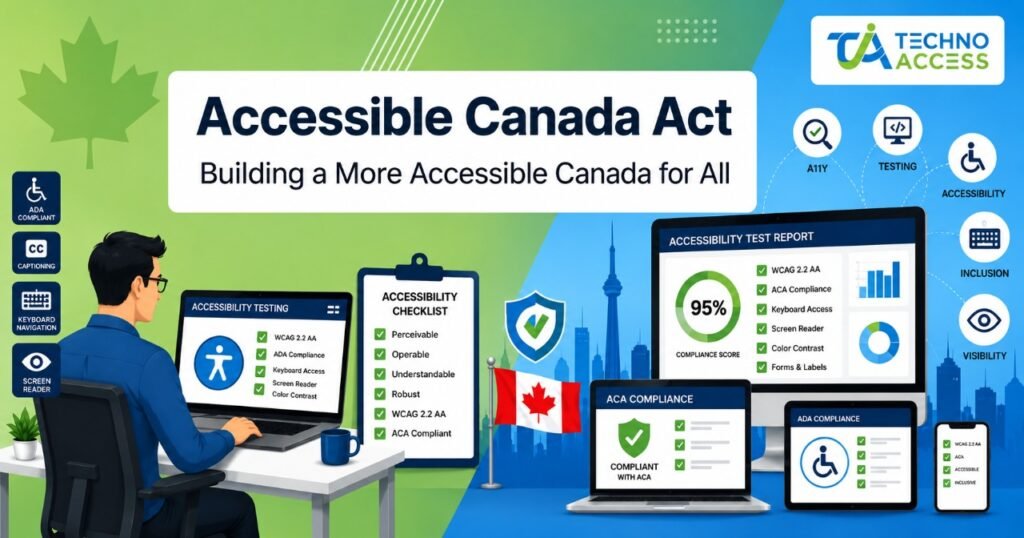


Canada has taken a landmark step toward becoming a barrier-free nation. The Accessible Canada Act (ACA), which came into force in July 2019, represents the country’s most comprehensive legislative effort to identify, remove, and prevent barriers to accessibility for people with disabilities. For businesses, federal agencies, and organizations under federal jurisdiction, understanding and complying with the ACA isn’t just a legal obligation – it’s a commitment to inclusion that strengthens your brand, broadens your audience, and future-proofs your digital and physical presence.
At Techno Access, we help organizations across Canada navigate the complexities of the Accessible Canada Act, turning compliance requirements into practical, actionable roadmaps. Web accessibility audit In this guide, we break down what the ACA means, who it applies to, and how your organization can meet its obligations with confidence.
The Accessible Canada Act is federal legislation designed to create a barrier-free Canada by 2040. It applies to organizations under federal jurisdiction, including the Government of Canada, Crown corporations, and federally regulated private sector industries such as banking, telecommunications, broadcasting, and transportation.
The ACA identifies seven priority areas where barriers must be identified and removed:
Rather than prescribing a single technical standard, the ACA takes a proactive, systemic approach. It requires regulated entities to identify, remove, and prevent barriers – not simply respond to complaints after the fact. This forward-looking model means organizations must continuously assess their policies, practices, and digital assets, including websites and applications, to ensure they don’t create new obstacles for people with disabilities.
A common misconception is that the ACA applies to every Canadian business. In reality, it applies specifically to entities within federal jurisdiction. This includes:
Organizations that fall under this scope with 100 or more employees are required to publish accessibility plans, establish feedback processes, and produce progress reports on a recurring schedule set by the Accessibility Commissioner.
That said, provincially regulated organizations shouldn’t tune out. Many provinces – including Ontario (AODA), British Columbia, Manitoba, and Nova Scotia – have their own accessibility legislation modeled on similar principles. If your organization operates nationally or serves federally regulated clients, aligning with ACA standards early is a smart, low-risk strategy. Our team at Techno Access regularly works with businesses navigating overlapping federal and provincial requirements, helping them build a single, unified accessibility strategy rather than juggling separate compliance efforts. You can learn more about how we approach multi-jurisdiction compliance on our accessibility compliance services page.
The ACA’s compliance framework rests on three pillars, and getting each one right requires careful planning.
Regulated organizations must publish an accessibility plan that outlines how they will identify, remove, and prevent barriers across the seven priority areas. Plans must be developed in consultation with persons with disabilities and updated at least once every three years. A well-constructed plan isn’t a static document – it should reflect a genuine audit of your physical spaces, digital platforms, HR practices, and customer-facing services.
Organizations are required to establish a mechanism for the public and employees to submit feedback about accessibility barriers. This feedback must be reviewed, considered, and – where appropriate – acted upon. A transparent, accessible feedback process signals that your organization treats accessibility as an ongoing conversation, not a one-time checkbox.
Following the initial plan, organizations must publish progress reports describing the steps taken toward removing identified barriers and implementing feedback received. These reports demonstrate accountability and keep accessibility efforts visible to stakeholders, regulators, and the public.
Because digital properties are often the most complex and highest-risk area for non-compliance, many organizations start their ACA journey with a thorough website and application audit. Techno Access offers detailed web accessibility audit services that map your digital presence against WCAG 2.1 standards – the technical benchmark most commonly referenced when demonstrating ICT compliance under the ACA.
Information and Communication Technology (ICT) is one of the seven priority areas explicitly named in the Accessible Canada Act, and for good reason. Websites, mobile apps, online forms, and digital communications are often the first – and sometimes only – point of contact between an organization and the public. If these platforms aren’t accessible, people with visual, auditory, motor, or cognitive disabilities may be excluded entirely from essential services.
Common digital barriers include:
Techno Access specializes in identifying and resolving these issues through comprehensive testing, remediation, and staff training. Our WCAG compliance solutions are built specifically to help organizations meet both ACA expectations and international accessibility benchmarks, ensuring your digital properties work for every user, regardless of ability.
Non-compliance with the Accessible Canada Act carries real consequences. The Accessibility Commissioner has the authority to issue compliance orders, conduct inspections, and impose administrative monetary penalties on organizations that fail to meet their obligations. Beyond regulatory risk, non-compliance can result in reputational damage, lost business opportunities, and reduced trust among customers and employees.
On the other hand, organizations that embrace accessibility proactively often see measurable benefits: expanded market reach (over 6 million Canadians report having a disability), improved SEO and usability for all users, stronger employee retention, and a demonstrable commitment to corporate social responsibility. Accessibility isn’t a cost center – it’s an investment in long-term resilience and inclusivity.
Contact Techno Access today for a personalized accessibility consultation. Our experts will assess your current standing, identify priority barriers, and build a clear roadmap toward full compliance.
Reach out now to schedule your free consultation and take the first step toward a more accessible, inclusive future.
The Accessible Canada Act is federal legislation that identifies, removes, and prevents barriers for people with disabilities nationwide.
The Accessible Canada Act came into force in July 2019, marking a major milestone in Canada's push for a barrier-free future.
Banks, airlines, telecoms, and broadcasters must comply with the Accessible Canada Act's accessibility and barrier-removal requirements.
Employment, built environment, ICT, communication, procurement, programs, and transportation are covered under the Accessible Canada Act.
Yes, entities with 100+ employees must publish accessibility plans as required by the Accessible Canada Act every three years.