
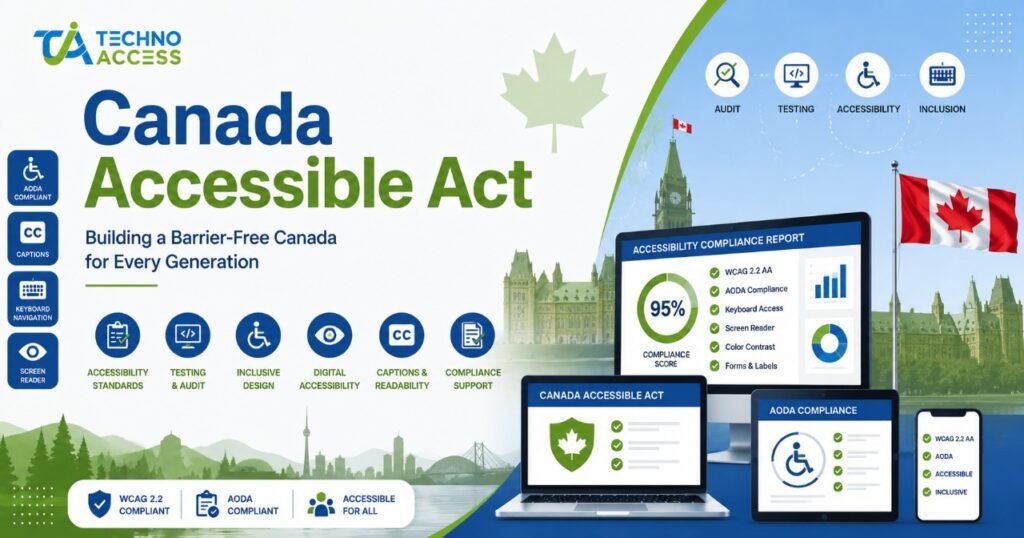


Canada is working toward an ambitious national goal: a barrier-free country by 2040. The vehicle driving that goal is the Canada Accessible Act, federal legislation that has fundamentally changed how government departments, Crown corporations, and federally regulated businesses approach accessible canada act vs provincial laws.Rather than treating accessibility as an afterthought, the law demands a proactive, systemic response – one that touches everything from hiring practices to website design.
For organizations trying to figure out exactly what’s expected of them, the details can feel scattered across legal language and policy documents. At Techno Access we translate that legal framework into a clear, actionable plan. This guide walks through what the Canada Accessible Act requires, how compliance timelines work, and the practical steps your organization can take today.
Enacted in 2019, the Canada Accessible Act was built around a simple but powerful principle: accessibility shouldn’t depend on individuals fighting for accommodations after encountering a barrier. Instead, organizations are legally required to find barriers before they cause harm and eliminate them systematically.
The legislation organizes its requirements around seven priority areas:
This structure means compliance isn’t a single project with a finish line – it’s an ongoing discipline woven into how an organization plans, hires, builds, and communicates. Organizations that treat it as a one-time initiative typically fall behind as new barriers emerge with every product launch, office renovation, or policy change.
Scope matters enormously here, since the Canada Accessible Act does not apply universally to every business in the country. It specifically covers organizations under federal jurisdiction, including:
Federally regulated organizations with 100 or more employees carry the most substantial obligations, including publishing accessibility plans, maintaining a public feedback mechanism, and issuing progress reports on a schedule set by the Accessibility Commissioner.
Organizations outside this direct scope – provincially regulated businesses, for example – aren’t off the hook entirely. Many provinces have enacted their own accessibility legislation with similar goals, and federal contractors or suppliers are often expected to demonstrate accessible practices as a condition of doing business with regulated entities. If your organization works with or supplies federally regulated clients, understanding these expectations early can be a genuine competitive advantage. Our VPAT Report Services & Accessibility page walks through how we help organizations determine exactly where they stand, regardless of jurisdiction.
Every regulated organization under the Canada Accessible Act must satisfy three interconnected obligations. Understanding how they work together is key to building a compliance program that holds up over time.
An accessibility plan is a public document describing how an organization will identify, remove, and prevent barriers across the priority areas. Plans must be developed with direct input from people with disabilities and refreshed at least every three years. The strongest plans go beyond vague commitments – they include specific, measurable actions tied to realistic timelines.
Organizations must create a clear channel for the public and employees to report accessibility barriers. Just as importantly, that feedback needs to be reviewed and acted on, not simply logged and forgotten. A well-designed feedback process turns accessibility into an ongoing conversation between an organization and the people it serves.
Following the initial plan, organizations must regularly report on the concrete steps taken to remove barriers and respond to feedback. These reports create accountability and give stakeholders – from regulators to customers – a transparent view of how seriously an organization takes its obligations.
Because digital platforms are frequently the most complex piece of this puzzle, many organizations begin their compliance journey with a detailed website assessment. Techno Access provides thorough web accessibility audit services that benchmark your digital properties against WCAG 2.1, the technical standard most closely tied to ICT compliance under the Act.
Of the seven priority areas named in the Canada Accessible Act, information and communication technology has become one of the most scrutinized – and for good reason. Websites, mobile apps, and online portals are often the primary way people interact with government services and regulated businesses. When these platforms aren’t built with accessibility in mind, they can quietly exclude a significant portion of the population.
Frequent digital barriers include:
Of the seven priority areas named in the Canada Accessible Act, information and communication technology has become one of the most scrutinized – and for good reason. Websites, mobile apps, and online portals are often the primary way people interact with government services and regulated businesses. When these platforms aren’t built with accessibility in mind, they can quietly exclude a significant portion of the population.
Frequent digital barriers include:
Techno Access resolves these issues through structured testing, hands-on remediation, and training that helps internal teams maintain accessibility long after the initial fix. Our WCAG compliance solutions are designed specifically to align digital properties with both the technical requirements of WCAG and the broader expectations set out under the Canada Accessible Act.
The Accessibility Commissioner has real enforcement power under the Canada Accessible Act, including the ability to conduct inspections, issue compliance orders, and levy administrative monetary penalties against organizations that fail to meet their obligations. Beyond the direct financial risk, non-compliance can damage public trust, invite negative media attention, and put organizations at a disadvantage compared to competitors who’ve already invested in accessibility.
The upside for early movers is substantial. More than 6 million Canadians live with a disability, representing significant untapped market potential for organizations that make their products and services genuinely usable. Accessible design also tends to improve the experience for all users – clearer navigation, better readability, and more intuitive interfaces benefit everyone, not just people with disabilities.
Contact Techno Access today for a tailored accessibility consultation. Our team will evaluate your current policies, facilities, and digital platforms, then map out a practical path toward full compliance with the Canada Accessible Act. Reach out now and take the first confident step toward a truly accessible organization.
The Canada Accessible Act is federal legislation requiring organizations to identify, remove, and prevent barriers for people with disabilities.
The Canada Accessible Act came into force in 2019, setting a goal of a barrier-free Canada by 2040.
The Canada Accessible Act aims to make Canada completely barrier-free for people with disabilities by the year 2040.
Banks, airlines, telecoms, and federal agencies must comply with the Canada Accessible Act's barrier-removal requirements.
The Canada Accessible Act covers employment, built environment, ICT, communication, procurement, programs, and transportation.